

CIAM Metrics Mind Map
This ebook helps you connect the dots between the different goals, strategies and tactics at play in a customer identity and access management (CIAM) project.
Why a mind map?
It’s easy to get lost in the weeds when you’re working to simplify your customers’ sign-in journeys. In fact, we see it quite a bit. IT, marketing, customer experience and security teams are – understandably – coming into the project with different goals, strategies . . . and success metrics.
Sometimes it’s hard to zoom out and explain the big picture to your execs. Other times it’s hard to zoom in and figure out how to actually measure the thing you’re trying to change. No matter where you sit (or who you’re talking to) we hope this mind map helps you see the relationships between all of the different goals, strategies and tactics at play when you’re improving your customers’ sign-in journeys.
3 Big financial metrics
If you’re talking to C-level execs it’s always handy to start with the top line financial metrics. How does <insert your project here> reduce costs or increase revenue. Improving your customers’ sign-in journey moves the needle on both.
That's why we've linked everything back to three metrics:
1. Reducing costs
- Improve efficiency for staff that serve customers
- Reduce IT operation costs
- Reduce fraud
- Reduce 3rd party commissions
2. Growing the # of customers
- Simplify the new account creation process
- Simplify sign-in
- Simplify purchasing/provisioning process
- Improve site performance for sign-in journeys
- Increase customer referrals
3. Increasing revenue per customer
- Reduce account abandonment
- Increase customer engagement
- Increase customer upsell
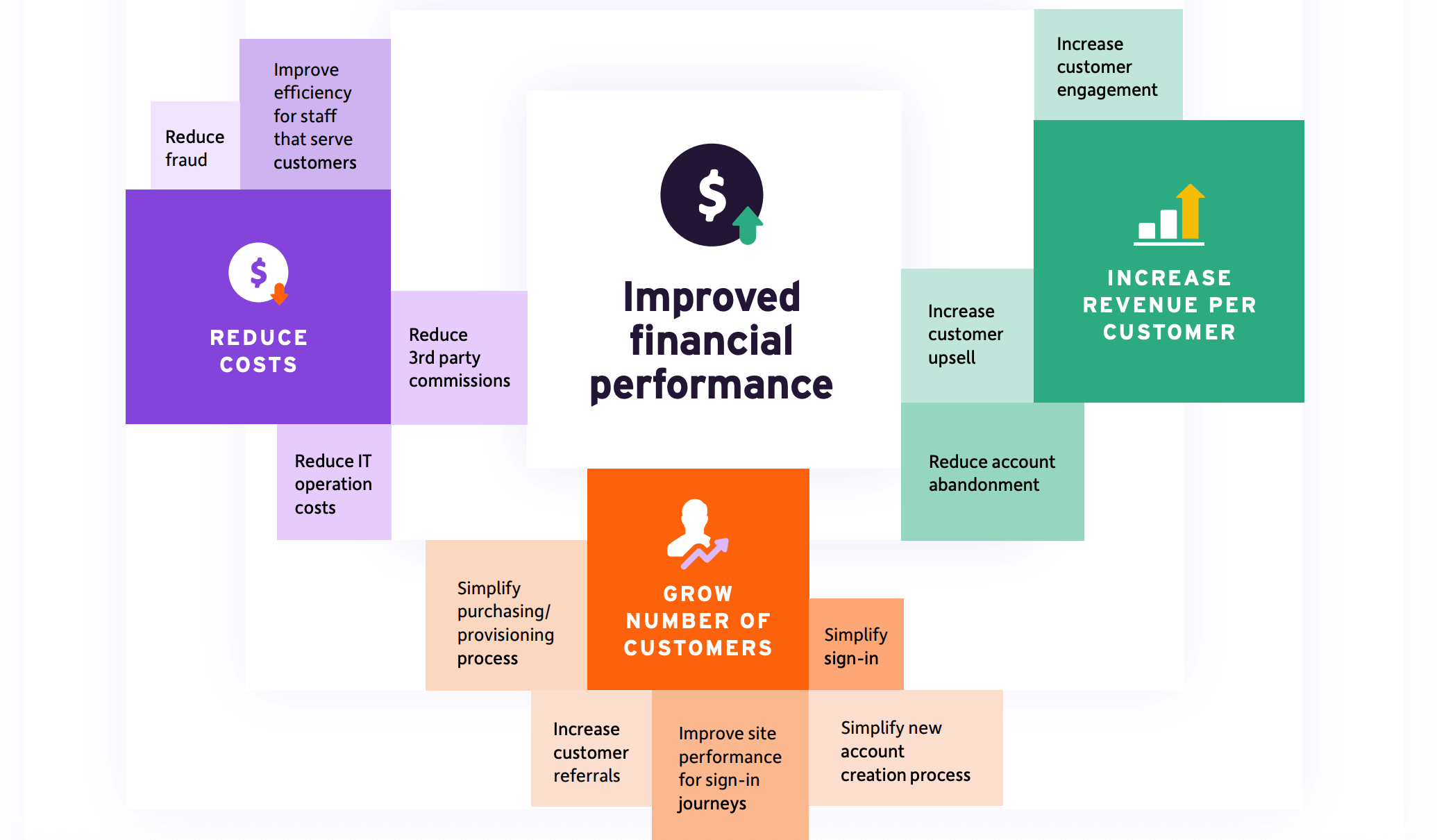
1. Reduce costs
2. Grow number of customers
3. Increase revenue per customer
How to use the mind map
How you use this mind map will depend on your goals. Here are a few scenarios where it can help.
3 use cases:
- Refine your strategy:
If you’ve got a top-down execu-edict that’s related to one of the three big financial metrics, start there. For example, if the priority is to grow the number of customers faster, find that on the map and then look at the related strategies and tactics. See what makes sense for your situation and go from there.
- Pick a metric and work backwards:
Sometimes there are more specific metrics you’re trying to move. For example, increasing the percentage of users that complete the account creation process. No problem. Scan the list of strategic metrics on either side of the map and work your way back towards the center to see which tactics could move the needle.
- Communicate to your peers (and execs):
Broadly speaking, if you’re in IT or security you’re likely to be more focused on the left side of the map: reducing costs. And if you’re in marketing, product management or customer experience you’re probably living over on the right-hand side most of the time. Either way, make sure you familiarize yourself with what your peers care about. And no matter who you’re talking to help connect the dots for them back to one of the big three financial metrics.
Cost reduction
When it comes to sign-in journeys it’s easy for costs to slowly grow out of control. When things get too expensive, reducing costs can become the driving force for revamping your approach. Of course, whenever customer accounts are hijacked it’s all hands on deck to figure out how to lock things down so it doesn’t happen again.
4 Major strategies for reducing the cost (and risk) of sign-in journeys.
- Reduce IT operations costs:
Go beyond the licensing costs. Add up all of the ongoing costs for software licenses, third-party professional services and the time your engineering team (and auditors) spend maintaining and updating the tech that supports the customer sign-in process. Divide by the # of monthly active users (MAUs) and you’ve got your operational costs.
- Improve efficiency for staff that serve customers:
As customers do more online you’ll need fewer people to support face- to-face interactions. Measuring can be tricky. If possible, you want to get some measure of the % (and trend) of customer interactions done online (vs. off-line). Then, sleuth out how many employees you can free upas more transactions move on-line.
- Reduce fraud:
Like many things in security, your two go-to metrics here are the #of incidents and the direct financial impact from fraud. In this case we’re specifically measuring fraud related to customer account takeovers. Make sure to also add up the time it takes to investigate customer-related fraud incidents. Often, the lack of simple and centralized auditing and logging can suck up a good bit of your security analysts’ time.
- Reduce 3rd party commissions:
If your organization gets a lot of business via referral partners like online reservation systems, and food delivery services you probably also pay a lot in commissions. Improving your own customers’ sign-in journeys can make it easier to book more business direct (and reduce commissions).
Revenue growth
While there are all sorts of strategies to grow revenue we’ve stuck to ones that are specifically related to improving or optimizing customers’ online sign-in journeys. We’ve found it helpful to split revenue growth into two buckets: growing the total number of customers and increasing how much each customer spends with you.
5 Major strategies for growing the number of customers with simpler sign-in journeys.
- Simplify the new account creation process:
It takes a lot of work to get a user to the “signup” page. Strategies for increasing conversion rates most often focus on allowing users to use an existing login (like a social media account) to authenticate. Automating the identity verification process is another popular strategy. Just make sure you work with the security team to balance customer experience with the checks required to mitigate the risk of fraud and account takeovers.
- Simplify sign-on:
There’s a natural tension between marketing– who wants to simplify sign-in journeys – and security teams that need to reduce account takeover risk. These tactics mostly revolve around automating identity verification and reducing the clicks for users to log in. Success is pretty simple. You want to measure the percent of users that successfully complete the sign-in process.
- Simplify purchasing/provisioning process:
If it’s feasible, letting customers try (or buy) a product without talking to sales is an increasingly popular strategy. B2B companies often run into challenges with creating and checking user entitlements or making the provisioning process as seamless as customers expect. A good customer identity and access management system can automate entitlement checks and get users into your product quickly.
- Improve site performance for sign-in journeys:
There’s nothing more frustrating than a login screen that hangs while you’re trying to do something urgent (like placing a food delivery order on your way home). This is where your vendor’s architecture matters. Newer SaaS-based solutions can typically auto-scale when demand spikes while older “on prem” systems require a lot more TLC (and investment) to handle spikes in demand.
- Increase customer referrals:
Your best new customers come from referrals. This strategy focuses on making it Sesame Street simple for users to invite their friends (and get a bonus in the process).
Increase revenue per customer
Once you’ve done the hard work of signing up a new customer, you can focus on this second group of strategies to grow revenue. While your customers’ satisfaction with your product or service are the biggest factor there are several sign-in journey strategies that can help boost your revenue per customer.
3 Major strategies for helping boost your revenue through your customers’ sign-in journeys.
- Increase customer upsell:
This strategy is less about the customer experience and more about what you do with your customers’ data. For example, if you’re a pizzeria you probably don’t want to promote pepperoni specials to a vegetarian. Too often orgs simply can’t capture seemingly basic data about their customers – or get a 360° view of their combined engagement across both in-person and online interactions. That’s what these strategies focus on.
- Increase customer engagement:
This may be the most straightforward strategy. In short, once users log in let’s keep them engaged. That comes through personalization and improved design and user experience.
- Reduce account abandonment:
If your users only log in a few times a year (or your login process is super clunky) this strategy is a good place to start. If it’s too hard to recover an account, customers tend to just create a new one. When that happens you lose all of their history which makes it harder to pursue the other two strategies in this quadrant of the mind map.

Prefer a PDF?
Download the full Ebook to read offline or share.

Schedule a time to meet with us
Just starting your CIAM research? Ready for a product demo? Curious about replacing your current CIAM solution? Schedule time with one of our identity experts for a meeting tailored to your specific needs.