

CIAM vs IAM
Customer Identity and Access Management (CIAM) and Identity and Access Management (IAM) address fundamentally different challenges, serve different audiences, and require different approaches.
This page explains what each discipline covers, where they overlap, and how to evaluate which one applies to your situation.
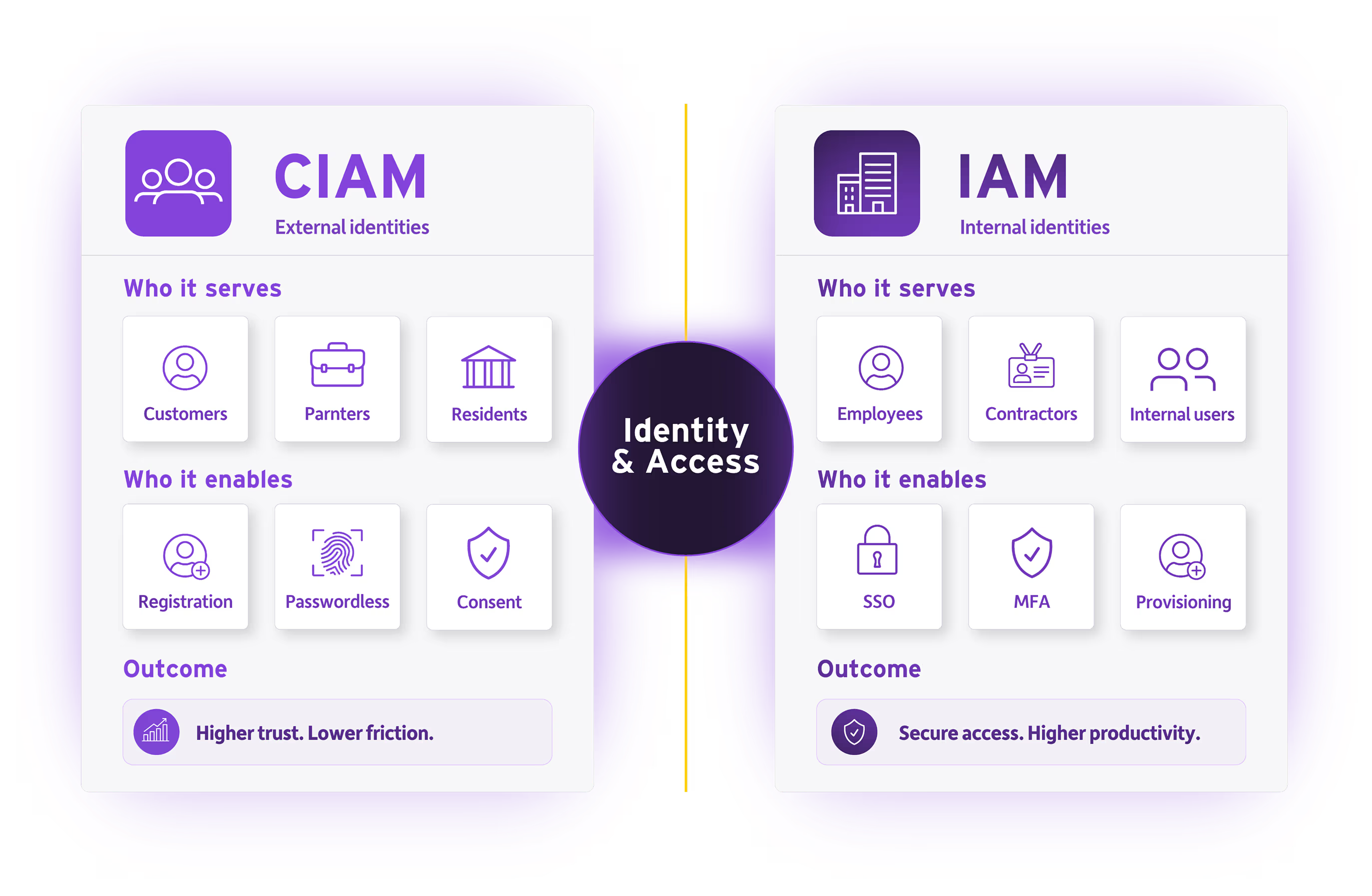
CIAM vs IAM: key differences
The table below summarizes the primary differences between CIAM and IAM across the dimensions that matter most to architects and buyers.
CIAM
Workforce IAM
Primary audience
Customers, partners, residents, external users
Employees, contractors, internal users
Scale
Millions of external identities
Thousands of internal users
User experience
Low-friction, brand-consistent, conversion-focused
Controlled, policy-driven, productivity-focused
Registration
Self-service, progressive profiling
IT-provisioned or HR-driven
Authentication
Passwordless, social login, adaptive MFA
SSO, MFA, directory-based
Consent and privacy
Core requirement: consent capture, preference management
Not typically in scope
Fraud prevention
Active fraud prevention at registration and sign-in
Risk-based access decisions are handled as security policy
Data residency
Often a requirement for customer PII
Managed via internal IT policy
Performance demands
High: traffic spikes, global users
Moderate: predictable, office-hours usage
Regulatory drivers
GDPR, CCPA, NYDFS, PCI-DSS, EU AI Act, regional privacy laws
SOX, and internal compliance frameworks like SO2 and ISO 27001
Security
Intentional balance with UX, effective across channels and devices
Prioritizes security and access control, often at the expense of UX
What is CIAM?
Customer identity and access management (CIAM) manages how customers, partners, residents or AI agents register, authenticate, and access digital services.
CIAM enables:
- Account opening and sel-service registration at scale
- Adaptive and passwordless authentication for consumer audiences
- Consent management and privacy preference capture
- Progressive profiling to reduce friction during onboarding
- Fraud prevention at the point of registration and sign in
- Identity orchestration across complex digital journeys
- Data residency and regulatory compliance for customer PII
CIAM solutions must handle millions of external identities, deliver seamless experiences that support conversion and retention, and adapt to varying regulatory requirements across regions. The performance, flexibility, and user experience requirements are fundamentally different from workforce IAM.

What is IAM?
Identity and access management (IAM) controls employee, contractor and internal user access to an organization's systems.
IAM capabilities include:
- Single sign-on (SSO) for internal applications
- Multi-factor authentication (MFA) for workforce users
- Role-based access control and permissions management
- Identity governance and lifecycle management
- Privileged access management for sensitive systems
IAM is designed for predictable, policy-driven environments where users are known, their roles are defined, and access patterns follow organizational structures. Employees have little choice over which systems they use, so experience is not such a competitive advantage.

Where CIAM and IAM overlap
Both CIAM and IAM rely on authentication protocols such as OAuth 2.0 and OpenID Connect, both enforce access policies, and both require secure credential management.
The distinction becomes important when selecting tools and defining ownership. A workforce IAM solution applied to a customer-facing use case will typically underperform on experience, scale, and consent management. A CIAM solution used as a workforce tool will lack the governance and provisioning capabilities internal IT teams expect.
Organizations with mature identity programs often operate both disciplines in parallel.

A third identity type: AI agents
The emergence of AI agents acting autonomously across applications and services is introducing a third identity category that sits alongside human customer and workforce identities. AI agents require authentication, authorization, consent, and auditability in ways that pre-existing IAM and CIAM architectures were not designed to handle.

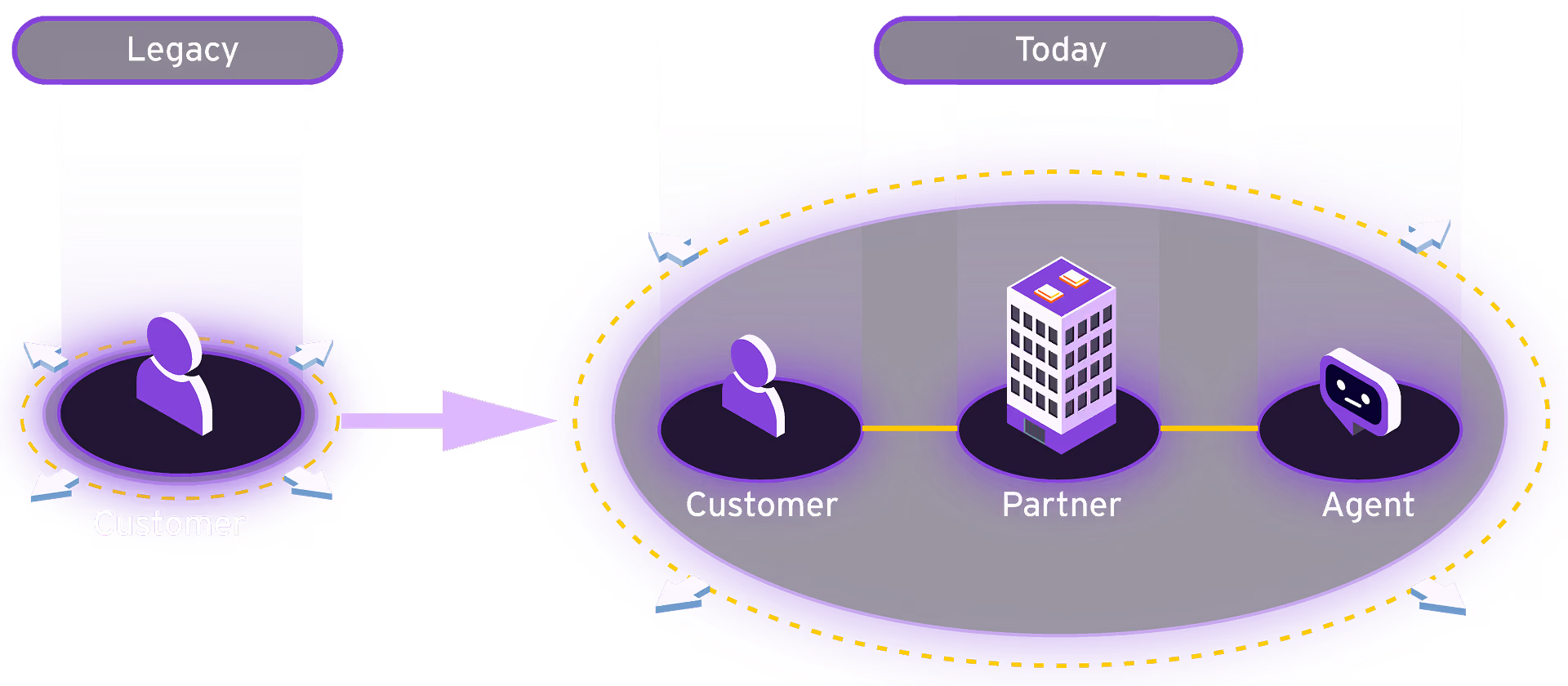
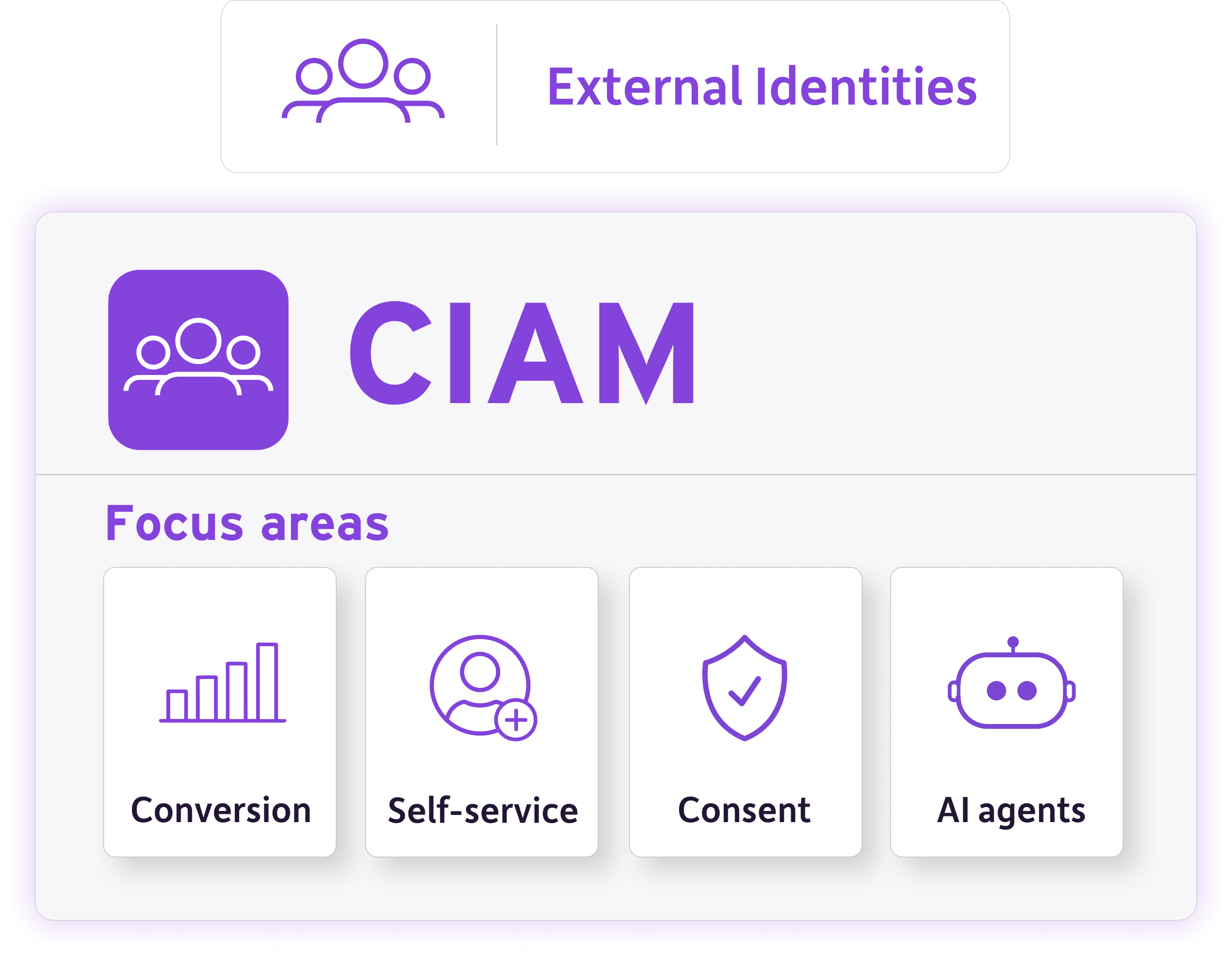
Per Forrester's CIAM category definition, agentic AI IAM is now considered part of the CIAM discipline. Organizations deploying AI agents in customer-facing contexts are extending their CIAM infrastructure to govern these non-human identities using the same controls applied to customers and partners.

Which does your organization need?
Most mid-market and enterprise organizations need both, serving different populations through different systems. The question is usually not IAM or CIAM, but whether you have the right solution for each use case.
CIAM is the right focus if:

Workforce IAM is the right focus if:

Frequently asked questions
CIAM is a discipline within the broader IAM category, but it addresses a distinct set of use cases, audiences, and technical requirements. Most analysts and vendors treat CIAM as a separate market with its own evaluation criteria and tooling.
Workforce IAM solutions can be extended to cover some customer identity use cases, but they typically require significant customization and struggle with the scale, experience, and consent management requirements that CIAM is built for. Most organizations find it more cost-effective to use a purpose-built CIAM solution for customer-facing use cases.
Workforce IAM typically manages thousands of internal users with predictable access patterns. CIAM must handle millions of external identities with variable traffic, seasonal spikes, and diverse device and channel requirements.
Most organizations with both internal users and customer-facing digital services operate both. They serve fundamentally different populations and the tool requirements rarely overlap enough to justify a single solution.
Customer identity data is subject to privacy regulations that vary by region, including GDPR in Europe and CCPA in California. CIAM solutions with built-in data residency controls allow organizations to store and process customer PII within specific geographic boundaries to meet these requirements.
How Strivacity approaches CIAM
Strivacity is a CIAM solution that helps brands manage customer, partner, and AI agent identities in a single product. It brings together identity orchestration, adaptive access, consent management, fraud prevention, and customer insights to support the full range of CIAM use cases without adding complexity.
.avif)