

One identity product for customers, partners, and AI agents
See why teams are leaving Okta, Auth0, and Ping Identity for a modern customer identity product that does more and costs less to own.

Why teams are switching from Ping, Okta, and Auth0

Costs that climb and surprise
Separately licensed add-ons and renewal hikes keep the bill growing, rarely in ways you can predict.

A stack to assemble and maintain
Equivalent capability takes several products, plus the integration and operations work to run them.

Slow time to market
Getting live takes months, and every new customer experience after launch adds more delay.

Customer AI agents go unseen
As customers turn to AI agents, incumbent tools have no way to track them, scope what they access, or keep the customer in control.
Recognized in the Forrester Wave for Customer Identity and Access Management, with top scores in more criteria than any other vendor evaluated.

CISO
"Strivacity replaced Ping Identity without a hitch. We retired 80% of our custom code and are now saving hundreds of thousands a year. Most importantly, conversion rates are up."

CISO
"Strivacity gave us a secure, modern online experience for customers while saving us $2M vs what we spent with Okta and Ping Identity."

VP, CISO
"Strivacity was the best solution. It went live within weeks and was significantly cheaper than Okta or Ping Identity. We didn’t need to hire anyone to manage it."
Why choose Strivacity?
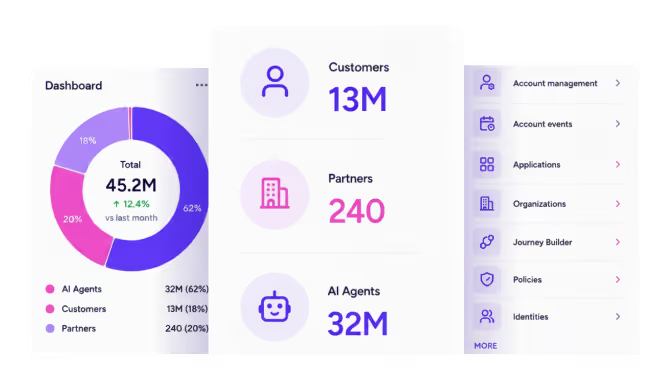
Govern customer, partner, and AI agent identities together in one place.
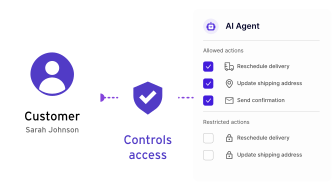
Put customers in control of what their AI agents can access, do, and act on.
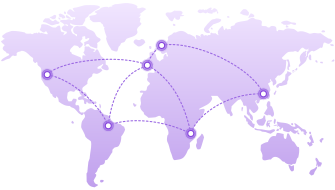
Your data stays where you put it. What others treat as an add-on, we include by default.
Extend what works and replace what doesn't, so you can move at your own pace, not all at once.
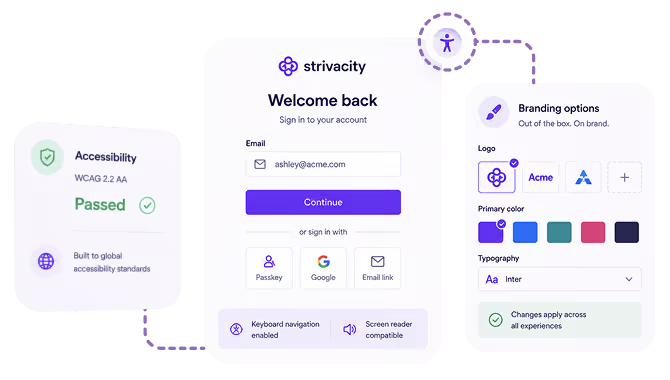
Configure identity journeys for speed. Extend with APIs and SDKs where you need it.

Migrate at next login or in bulk, and take your hashes with you, so no customer has to reset.

Strivacity vs Ping vs Okta: how the three compare
These differences are structural, not a feature checklist: how each vendor is architected, packaged, and priced. Strivacity governs customer, partner, and AI agent identity in one product on a dedicated instance, where Okta and Ping deliver the same scope across multiple products and tiers.
What to compare
Time to migrate


Password hash portability (in and out)
Commercial model
Architecture and data residency
Customer, partner, and AI agent identity
Changing identity journeys
Okta markets two customer identity products: Auth0 (developer-first, on separate infrastructure) and Okta Customer Identity. These differences are structural, not a feature checklist. They reflect how each vendor is architected, packaged, and priced.
.svg)
