


The Black Friday promo abuse checklist: stop new account fraud without adding friction

Black Friday is a major opportunity for retailers to drive signups and convert new customers. It’s also an opportunity for people, and bots, to create fake accounts for promo abuse, farming welcome discounts, promo codes, referral bonuses, and loyalty rewards. While the risk is there year-round, it’s particularly high around Black Friday when retailers are running more high-value promotions while trying to acquire customers at speed.
So how can retailers keep account opening seamless, converting the most customers possible, while strengthening security against new account fraud and promo abuse? The answer is to make smarter decisions at the identity layer. With the right identity setup, security and digital/CX teams can identify higher-risk behavior and introduce additional checks where needed, without adding unnecessary friction for legitimate customers.
This checklist will help you decide what identity decisions are right for your brand, so you can reduce promo abuse and new account fraud while keeping the customer experience as seamless as possible.
Why Black Friday creates the perfect conditions for promo abuse
During Black Friday events, retailers compete hard for new customers, often offering welcome discounts, one-time promo codes, referral bonuses and/or loyalty incentives. To convert as many customers as possible, they may also use this opportunity to simplify account opening and checkout. The combination of valuable incentives and low-friction account opening creates a higher risk for fraud.
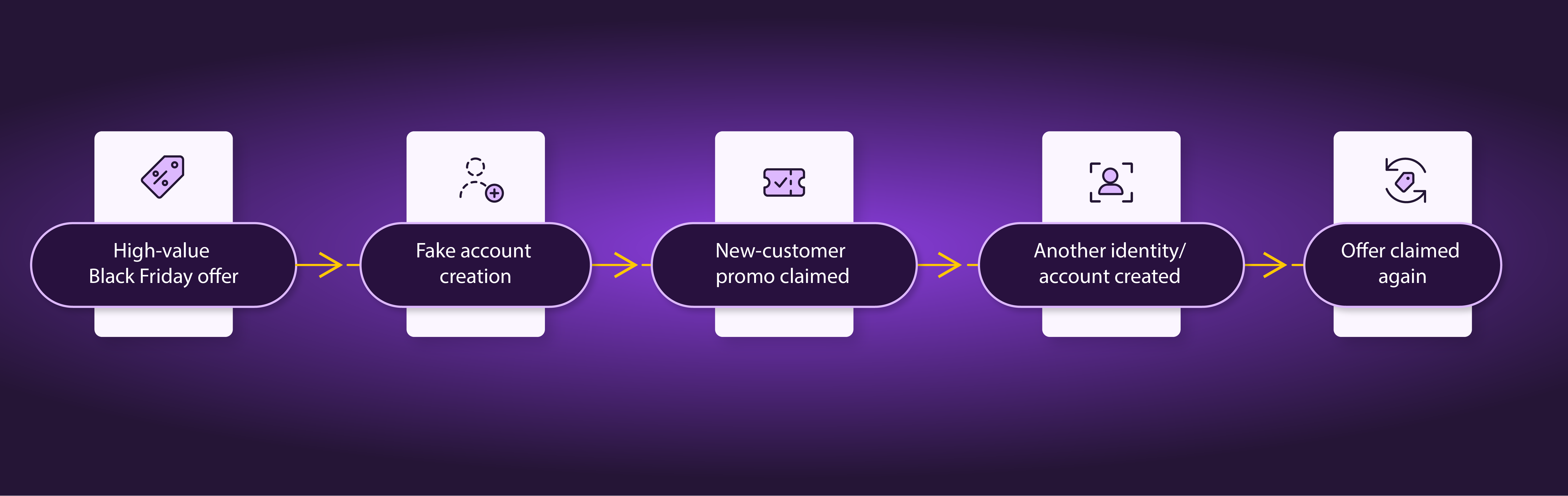
Promo abuse is the misuse of promotional offers in ways they were not intended, such as creating several identities to redeem a single-use discount multiple times. New account fraud is the creation of accounts using false or duplicated identities for fraudulent purposes. The two often overlap as promo abuse can depend on fake account creation, where offers are restricted to new customers or one redemption per customer.
If one person can appear to be a different new customer each time, they can repeatedly access benefits that were intended to be used just once. That’s why promo abuse is not only a bot problem or a payments problem. Bots can automate large-scale account creation, and payment controls may detect suspicious transactions later in the journey, but identity controls prevent issues earlier: who is creating this account, and how much confidence should you have in that identity?
Treating the issue at the identity layer gives retailers more control over the decision to approve a new account or permit a promo code. For example, rather than adding the same checks to every new account, they can assess risk during account opening and apply additional verification only when behavior looks suspicious. That helps security teams reduce new account fraud and promo abuse without forcing legitimate Black Friday shoppers through unnecessary friction.
The Black Friday promo abuse and new account fraud checklist
1. Identify which promotions are worth abusing
Start by mapping the promotions that create the strongest incentive for fake accounts. These may include new-customer discounts, one-per-customer promo codes, referral rewards, and free trials or credits.
Consider the value of each offer, how easily it can be claimed more than once, whether creating multiple accounts unlocks additional benefits, and how easily the abuse could scale. A £5 discount with strict redemption controls may carry far less risk than a high-value welcome offer that can be repeatedly claimed through new account creation.
This will help you to prioritize security where attackers have the most economic incentive, while avoiding unnecessary controls around promotions that carry little financial impact. This is also where you can distinguish ordinary enthusiastic bargain hunting from systematic promo abuse.
2. Stop automated fake account creation at signup
Bots can exploit Black Friday promotions by creating fake accounts at scale to repeatedly claim new customer discounts. Preventing this kind of promotion abuse starts at signup, not when a suspicious transaction takes place. Warning signs can include known bot activity, suspicious IP addresses, anonymous networks, and inconsistencies in customer identity information.
Effective fraud prevention combines these signals with customer identity data to identify and block suspicious registrations before accounts are created. A modern customer identity solution can apply risk-based controls during signup, stopping automated abuse while allowing legitimate customers to register without unnecessary friction.
3. Use risk-based authentication instead of blanket friction
Risk-based authentication (RBA) helps retailers create simple experiences for legitimate customers while introducing stronger security checks when behavior appears suspicious. RBA assesses risk signals around the user, device, behavior, and context, to determine the level of risk associated with account opening or sign in.
If those signals indicate that an interaction is low risk, the customer can proceed normally. If risk is detected, the journey can adapt by evaluating additional signals, triggering step-up authentication, or blocking the interaction altogether.
This ensures that genuine shoppers don’t have to jump through unnecessary hoops, making journeys easier to complete and helping protect conversion rates. At the same time, adaptive authentication enables retailers to apply stronger controls when the level of risk justifies them, rather than treating every customer as equally suspicious.
4. Keep registration short with progressive profiling
When verifying customer identity to reduce fraud, it’s tempting to ask for every piece of personal data. However, Black Friday is not the time to make customers complete long registration forms. Asking for too much information upfront can create unnecessary friction and increase the chance that shoppers abandon account creation or checkout altogether.
Instead, leverage your customer identity solution for progressive profiling. This requires minimal data up front, which helps to protect conversion rates. You can then collect additional data in subsequent customer interactions, when it is relevant to the journey or required to verify a higher-risk interaction. This builds a fuller customer profile over time, supporting more informed fraud detection (plus greater opportunities for service personalization!).
5. Preserve guest checkout where risk allows
It might be tempting to limit promo use to registered accounts, to tie promotions and rewards to a known identity. However, forcing account creation steps can lead to legitimate shoppers abandoning checkout.
Where risk allows, preserve guest checkout. Then require an account only if there is a clear reason for it, such as accessing specific loyalty benefits, managing subscriptions, or redeeming account-specific offers. For guest orders, limit one-time codes using signals such as email, payment method or device.
Customer identity controls can then focus on the journeys where identity matters most, rather than making account opening a universal requirement. This allows retailers to protect promotions and account-linked benefits while still supporting a more frictionless checkout experience for customers who do not need or want an account.
6. Protect existing accounts when Black Friday traffic peaks
Fraud risk doesn’t end once an account has been created. Existing customer accounts are also attractive targets, particularly when they contain saved payment details, loyalty balances, personal data, or access to exclusive promotions.
During peak traffic, suspicious sign in activity can be harder to distinguish from legitimate spikes in customer behavior, which are common during Black Friday events. That makes account takeover protection especially important. Retailers should assess risk signals at sign in and throughout the customer journey, looking for unusual devices, locations, behavior, or other changes that may indicate an account has been compromised. As with new account fraud, the aim should be to apply stronger controls only when the level of risk justifies them.
7. Treat loyalty and referral fraud as part of the same identity problem
Promo abuse rarely happens in isolation. One person may create multiple accounts, use those accounts to generate referral rewards, claim welcome offers, and accumulate loyalty points or other benefits intended for genuine customers.
This is why retailers should look beyond individual transactions and consider the relationships between accounts and identities. If several accounts share the same device, contact details, behavior patterns, or other identity signals, that may indicate that one person is operating multiple accounts to exploit promotions, commit referral fraud, or carry out loyalty reward fraud.
Taking an identity-led approach can help retailers spot these connections earlier and apply additional checks where the risk is highest. It also helps avoid placing unnecessary restrictions on legitimate loyalty members who are using offers as intended.
A better Black Friday strategy: make friction proportional to risk
Black Friday creates pressure to move fast. Retailers want to acquire as many new customers as possible, while security and fraud teams need to prevent fake accounts, promo abuse, and account takeover.
The answer is to be smart about where to introduce friction, and to make that friction proportional to risk. By making smarter identity decisions at account opening, sign in, and throughout the customer journey, retailers can keep low-risk customers moving while introducing stronger controls when suspicious behavior appears.
A customer identity platform like Strivacity can put these approaches into place, giving retailers the tools to identify and assess risk and adapt identity journeys without applying the same controls to every customer.
Ultimately, effective promo abuse and new account fraud prevention should make it harder for bad actors to exploit Black Friday offers, while keeping legitimate customers on the fastest possible path to purchase.
Promo abuse and new account fraud FAQ
What is promo abuse fraud?
Promo abuse is the misuse of promotional offers in ways they were not intended. This can include creating multiple accounts to repeatedly claim new-customer discounts, reusing promo codes, exploiting referral bonuses, or manipulating loyalty rewards. Promo abuse often overlaps with new account fraud because many promotions are limited to new customers or one redemption per person.
How do you detect promo abuse?
Promo abuse can be detected by looking for unusual patterns across account creation and customer behavior. These might include high signup velocity, multiple accounts associated with the same device or identifiers, repeated use of similar customer information, or other behavior that suggests one person is operating multiple accounts.
Using identity and risk signals together can help retailers distinguish legitimate customers from suspicious activity and introduce additional checks only when needed.
What is new account fraud?
New account fraud is the creation of a customer account using false, manipulated, stolen, or repeatedly reused identity information for fraudulent purposes. For retail, this might involve creating fake accounts to repeatedly access promotions, referral rewards, or other benefits intended for genuine new customers.
Because the fraud starts during account opening, identifying suspicious behavior at the identity layer can help retailers intervene before the account is established and leveraged for abuse.
What’s the best way to prevent new account fraud?
Effective new account fraud prevention starts by assessing risk during account opening. Retailers can use signals around the customer, device, behavior, and context to identify suspicious signups, then adapt the journey according to the level of risk.
Low-risk customers can continue with minimal interruption, while higher-risk interactions can trigger additional verification, step-up authentication, or get blocked. This helps retailers strengthen security without introducing the same level of friction for every new customer.
Is promo abuse illegal?
Whether promo abuse is illegal depends on the nature of the activity and the applicable laws and terms and conditions. Some behavior may simply breach a retailer’s promotional terms, while more serious activity involving stolen identities, payment fraud, deception, or unauthorized access could have legal consequences.
Retailers should clearly define the permitted use of promotions in their terms and work with their legal and fraud teams when determining how particular forms of abuse should be handled.
How can Strivacity help prevent promo abuse and new account fraud?
Strivacity customer identity and access management (CIAM) helps retailers identify and respond to suspicious behavior at the identity layer. Its adaptive access capabilities use risk signals such as device, network, location, and behavioral data to inform decisions during customer journeys, while built-in bot detection can help identify automated registration attempts.
Based on the level of risk, retailers can configure journeys to allow legitimate customers to continue normally, block suspicious registrations, or introduce additional authentication when needed. This helps make security controls proportional to risk rather than adding the same friction to every customer.