

Retail Identity & Metrics Mind Map
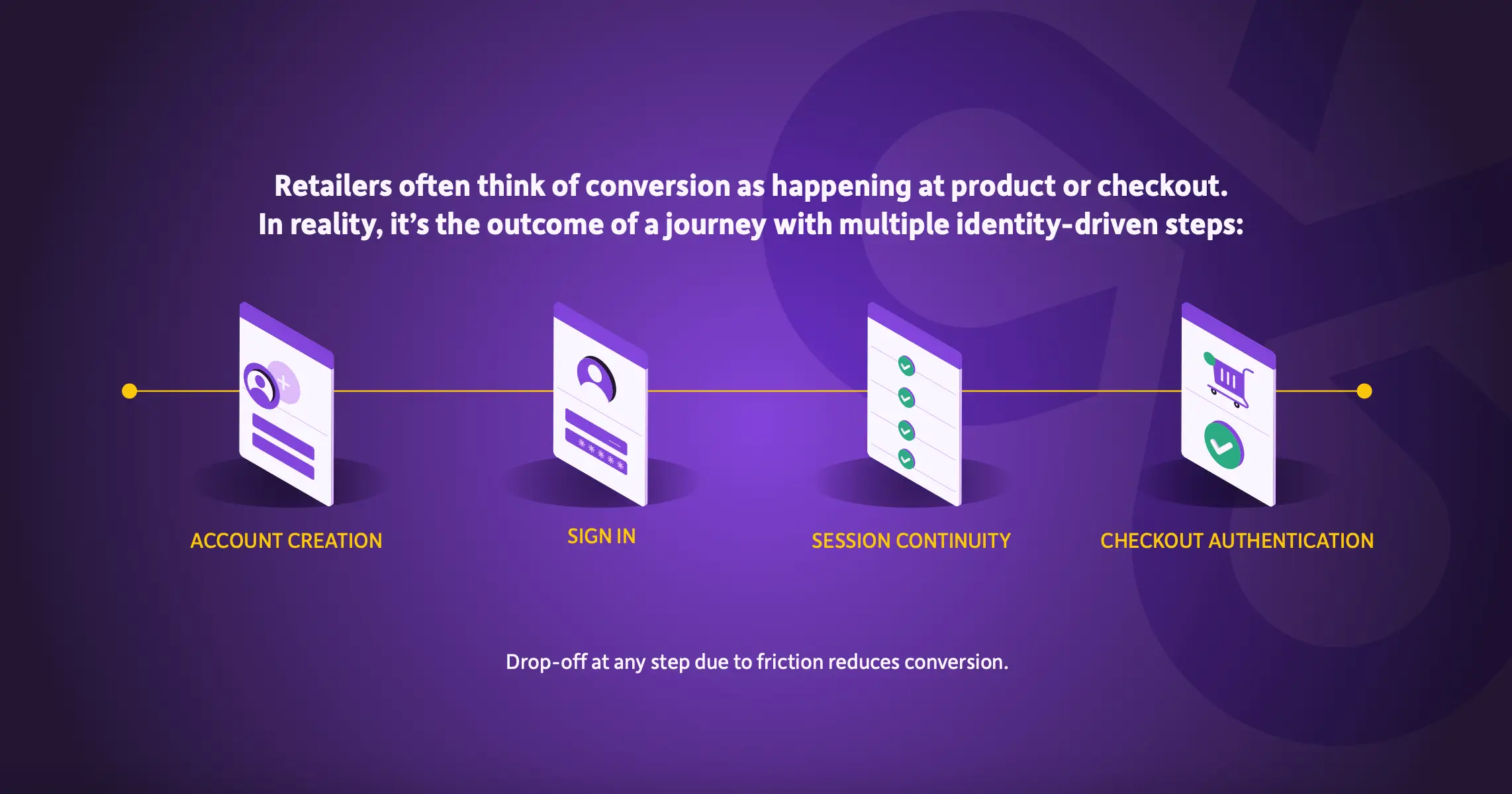
Identity sits in front of every high-value interaction: account creation, sign in, checkout, loyalty, and personalization. When identity creates friction, shoppers abandon.
Identity is where revenue is quietly lost
Identity sits in front of every high-value interaction: account creation, sign in, checkout, loyalty, and personalization. When identity creates friction, shoppers abandon. When it fails to protect, fraud follows. And when it buckles under peak traffic, the losses happen in the moments that matter most.
Yet identity remains one of the least measured parts of the retail stack. Most retailers have optimized checkout. Few have optimized the identity moments that happen before shoppers can pay or the infrastructure that needs to hold up when Black Friday, a flash sale, or seasonal surge hits.
For online retail businesses, this guide helps your security, digital, and product teams answer four critical questions:
- What business outcomes can identity improve?
- Which metrics expose the impact of identity on revenue, including mobile and at peak?
- Which strategies will move those metrics?
- How do teams align around an identity model that works for your business?
Retailers need an identity map
Retail identity is owned by multiple teams but rarely measured as a single system.
- Security focuses on fraud
- Digital focuses on conversion
- Product focuses on speed
- Marketing focuses on engagement
- Engineering focuses on uptime
The result is fragmented decisions, missed revenue, and no shared model for what “good” looks like. An identity map connects identity decisions to business outcomes like conversion, fraud reduction, loyalty, performance, and speed. It gives teams a shared model to prioritize and measure what matters.
Start with the outcomes your business already measures
Before diving into tactics, anchor your overall strategy to three outcomes that mean the most to leadership:
- Reduce costs. Stemming fraud losses, support costs, identity-related engineering overhead, and the operational burden of disconnected tools protects revenue.
- Grow the number of customers. Removing friction from account creation, sign in, and checkout directly improves conversion
- Increase revenue per customer. Strengthening loyalty, repeat purchases, recognition, and personalization across channels drives growth and long-term stability.
How identity impacts core retail KPIs
Identity directly impacts the metrics that retail leaders are accountable for:
The retail identity metrics mind map
BETTER RETAIL IDENTITY IMPROVES FINANCIAL PERFORMANCE ACROSS FIVE OUTCOME AREAS:
- Convert more shoppers
- Protect every account
- Build loyalty through trusted personalization
- Increase agility and lower total cost of ownership
- Prepare for AI-driven commerce
.avif)
Visible Simplicity.
Invisible Sophistication.
The best retail identity experiences feel effortless while doing far more behind the scenes than the customer ever sees. Aim for visible simplicity with invisible sophistication.
Identity performance benchmarks
Retailers often track checkout performance, but many of the biggest conversion gaps are driven by identity friction, not pricing or product.Before teams decide what to fix first, they need a clear view of what strong identity performance actually looks like. These benchmarks provide directional ranges to help retailers identify where performance is strong and where identity is negatively impacting revenue.
Source: Aggregated from industry research by Baymard Institute, Statista, Salesforce, Adobe, Stripe, MRC, and FIDO Alliance. Benchmarks represent directional ranges and vary by retailer and maturity.
These are not isolated metrics. They are signals that reveal how identity isperforming at the most critical moments in the customer journey
- Low sign in success: returning customers cannot complete purchase
- High password reset friction: abandoned carts from known users
- High false positives: legitimate customers blocked at checkout
- Low guest conversion: missed long-term customer value
- Low mobile sign in success: abandoned sessions on the highest-traffic channel
- Low omnichannel recognition: loyalty that erodes every time a customers witches channel
In many retail environments, 30–50 percent of cart abandonment is tied to identity-related friction, including authentication failures, recovery issues, and overly aggressive fraud controls. Even small improvements in sign in success, recovery, or false positive rates can translate directly into millions in recovered revenue for high-volume retailers.
Where to start
Most retailers do not need to start by measuring everything. They need to start with the metrics that expose the biggest leaks and highest revenue impact.
Start with the metrics that answer three questions:
- Where is identity creating revenue loss?
- Where is security creating unnecessary friction?
- Where is customer trust driving long-term value?
This starter set helps prioritize the highest impact metrics first before building a broader identity operating model.
Turning identity into measurable outcomes
To transform identity into a lever for growth, retailers must examine five key business drivers that hinge on identity performance:
.avif)
Understanding each one starts by identifying:
- the business problem retailers need to solve
- the priority actions that improve outcomes
- the metrics that show whether those actions are working
1. Convert more shoppers
Industry research from Baymard reveals that average cart abandonment rates hover near 70 percent, yet large-scale retailers can recapture up to 35 percent of that lost conversion by refining the checkout journey. Much of this revenue leakage is tied directly to identity friction during the critical moments of sign in, account creation, and recovery. This is echoed by the FIDO Alliance, whose 2025 data shows that 48 percent of shoppers have walked away from a purchase simply because they forgot a password—a failure point that is magnified on mobile, where abandonment happens in seconds.
Two specific patterns accelerate these losses. First, mobile sign in success rates typically lag 5 to 10 percentage points behind desktop performance, creating a significant revenue gap that often goes unmeasured. Second, authentication and recovery friction tend to spike during peak traffic surges, precisely when infrastructure strain and overly aggressive fraud controls are most likely to block legitimate customers. The result is a system that often performs worst exactly when and where the business needs it to perform best.
Priority actions
- Remove friction for returning customers:
Use passkeys, passwordless sign in, remembered devices, and adaptive authentication to eliminate unnecessary sign in barriers, especially on mobile. - Reduce account creation abandonment:
Use progressive profiling, social sign in, and streamlined registration flows to capture only what is needed upfront to reduce abandonment. - Optimize identity for peak traffic:
Use scalable authentication infrastructure, adaptive fraud controls, and step-level visibility so identity performs best when traffic is highest. - Support guest checkout without losing long-term value:
Enable post-purchase account conversion, identity linking, and saved preference capture to preserve long-term customer value.
Key metrics to track
2. Protect every account
Retail accounts are high-value targets. They hold personal data, saved payment methods, and stored value through loyalty programs. Attackers target these accounts because they can be monetized quickly and at scale. According to Verizon’s 2025 Data BreachInvestigations Report, 88 percent of attacks involve stolen credentials. In retail, that makes credential theft the primary entry point for fraud.
Credential theft drives account takeover at scale
Most retail fraud begins before a customer ever reaches your site. Attackers use breached credentials from other services and automate login attempts through credential stuffing and password spraying. Because customers reuse passwords, a single breach elsewhere can unlock thousands of retail accounts. The highest-risk moments are sign in and account recovery. Sign in is targeted at scale with automated attacks, while account recovery is often exploited to bypass authentication controls altogether.
This becomes significantly harder to manage during peak periods. High volumes of legitimate traffic make attack patterns more difficult to distinguish, and fraud controls that work under normal conditions often overcorrect, blocking real customers at the worst possible time. That creates a direct tradeoff between security and conversion when retailers can least afford it.
Loyalty fraud is where stolen access is monetized
Once attackers gain access, they move quickly to extract value. Loyalty programs are one of the easiest and most profitable targets. Loyalty points act like currency. They can be redeemed, transferred, or resold, often with less scrutiny than payment methods.
Priority actions
- Protect the front door and stop credential-based attacks:
Use bot detection, breached credential checks, and adaptive authentication at sign in to reduce account takeover. - Secure account recovery as a high-risk flow:
Add identity verification and adaptive controls to prevent attackers from by passing authentication through password reset. - Prevent fake accounts at registration:
Stop promotion abuse early with bot detection and identity checks. - Protect loyalty as stored value:
Apply step-up authentication and monitoring to high-risk actions such as redemption, transfers, and profile changes. - Continuously tune for peak periods:
Use unified fraud signals and real-time insights to reduce false positives while maintaining protection when traffic spikes.
Key metrics to track
3. Build loyalty through trusted personalization
Retailers grow loyalty when customers feel known, recognized, and remembered across every interaction. Known customers are significantly more valuable than anonymous ones. McKinsey & Company found that companies that excel at personalization generate 40 percent more revenue from those activities than average players, driven by repeat purchases, higher engagement, and improved retention.
But personalization only works when identity creates trust and continuity. Customers expect orderhistory, saved preferences, personalized offers, and loyalty benefits to follow them across web,mobile, app, store, and service interactions. They expect brands to recognize them without forcingrepeated sign ins, unnecessary friction, or disconnected experiences across channels.
The goal is not to collect more data. It is to create more relevant, trusted customer experiencesthat make customers return more often and generate greater lifetime value.
Priority actions
- Make recognition effortless across channels:
Use unified identity profiles, account linking, and omnichannel orchestration so customers are recognized consistently across every channel. - Prioritize trusted returning user experiences:
Use remembered devices, passkeys, passwordless access, and session continuity to reduce friction for returning customers. - Build trust before personalization:
Use centralized consent management, preference controls, and self-service profile management so personalization is based on trust and transparency. - Increase known customers over time:
Use progressive profiling and low-friction authentication to enrich customer profiles over time without creating registration barriers.
Key metrics to track
4. Increase agility and lower total cost of ownership
Retailers need identity that moves at the speed of the business. When every sign in page change, consent update, or new brand launch requires engineering time, identity becomes a bottleneck. Deloitte found that 44 percent of retail executives say legacy systems are slowing innovation. The Retail & Hospitality ISAC 2026 CISOBenchmark Report adds that 70 percent report IT prioritization challenges and68 percent cite budget constraints as major execution barriers.
Cost and speed problems compound at peak. Shared multi-tenant infrastructure can introduce performance variability when traffic spikes. Disconnected tools mean no unified view when something breaks during a revenue window. And the engineering effort required to debug a fragmented identity stack during a live event scales costs at the worst possible time.
Priority actions
- Reduce complexity before reducing spend:
Fewer systems create faster execution, lower support costs, and better visibility across identity journeys. - Remove engineering from routine changes:
Identity should move at the speed of the business, not the speed of backlog prioritization. - Treat identity like a conversion funnel:
Use testing, abandonment, and failure data to continuously improve performance. - Standardize before scaling:
Consistent identity flows across brands and applications reduce cost, duplication, and operational risk.
Key metrics to track
5. Prepare forAI-driven commerce
Retail identity is expanding beyond human users. Bain & Company estimates that US agentic commerce could reach $300– $500 billion by 2030, or roughly 15–25 percent of ecommerce. As AI-driven commerce grows, the challenge is not adoption, but control. Retailers must verify AI agents, govern what they can do, and maintain full visibility into every action.
This transition has already begun. AI shopping assistants are helping customers discover and purchase products. Automated agents are interacting with accounts and loyalty systems. AI-driven service experiences are modifying customer data.Most retailers are not yet measuring any of it.
Priority actions
- Treat AI agents as identities, not tools:
If an agent can act like a person, it must be verified, governed, and monitored like one. - Make authority explicit:
Every agent action should be tied to verified delegation, scope, and customer consent. - Apply adaptive controls to agent behavior:
High-risk actions should trigger step-up verification or human approval. - Maintain full auditability from day one:
Trust, compliance, and dispute resolution depend on proving who did what, when, and why.
For most retailers, this represents the forward edge of identity maturity.
If you are still working on sign in success rates and mobile conversion, start there. Apply these tips when agentic commerce becomes part of your roadmap.
Key metrics to track
What this requires from modern retail identity
Retailers do not need more identity tools. They need a simpler, unified way to manage identity across the customer journey. Today, identity is often fragmented across registration, authentication, fraud, consent, and customer data systems.
To support both growth and protection, retailers must:
- Connect the full identity lifecycle: From registration to sign in, loyalty, and recovery, identity cannot be fragmented across systems. Gaps create friction for customers and blind spots for the business.
- Balance conversion and protection in real time: Security should adapt to risk without disrupting legitimate customers. The same system that protects accounts should also support smooth sign in and checkout.
- Deliver consistent performance at scale: Identity infrastructure must hold up during peak demand, not just average traffic. Single-instance architecture, pre-tuned fraud thresholds, and load-tested recovery flows are essential for high-volume retailers.
- Win on mobile without a separate strategy: Mobile should not require a different identity stack. A unified system should support native mobile experiences such as passkeys, biometrics, and push authentication for every channel – without custom engineering.
- Provide visibility into identity performance: Teams need a clear view of where identity creates friction, where it reduces risk, and how it impacts business outcomes across every channel and traffic condition.
- Enable speed without heavy engineering: Identity should move at the pace of the business, allowing teams to launch, adapt, and improve without long development cycles.
Retail identity is now a growth metric
Every registration step, sign in prompt, password reset, consent interaction, and fraud check affects whether a shopper converts, whether they trust your brand, and whether they come back.
The retailers that win will measure identity the same way they measure checkout, loyalty, and customer experience: as part of the revenue engine. That means understanding where identity creates friction, where it reduces risk, and where it helps build stronger customer relationships over time.

Prefer a PDF?
Download the full Ebook to read offline or share.
.svg)
Schedule a time to meet with us
Just starting your CIAM research? Ready for a product demo? Curious about replacing your current CIAM solution? Schedule time with one of our identity experts for a meeting tailored to your specific needs.