

Customer Identity Metrics Mind Map for Financial Services
This mind map connects identity tactics to business outcomes that financial leaders care about including reducing fraud, improving compliance, and increasing digital account conversions.
The five business outcomes that matter most
When you’re talking to executives in banking, insurance, or wealth management, it pays to lead with what matters most in the boardroom: business outcomes.
Whether you’re modernizing authentication, meeting evolving compliance standards, or improving digital onboarding, leadership wants to know one thing: How does this drive growth, reduce risk, and improve compliance?
That’s why this mind map ties every strategy and metric back to five core levers:
- Lower operational costs
- Prevent fraud
- Increase account opening rates
- Grow revenue per customer
- Meet compliance requirements
Your identity platform influences all five. These are the outcomes that get buy-in from the board and they all depend on how smooth, secure, and scalable your sign-in experience is.
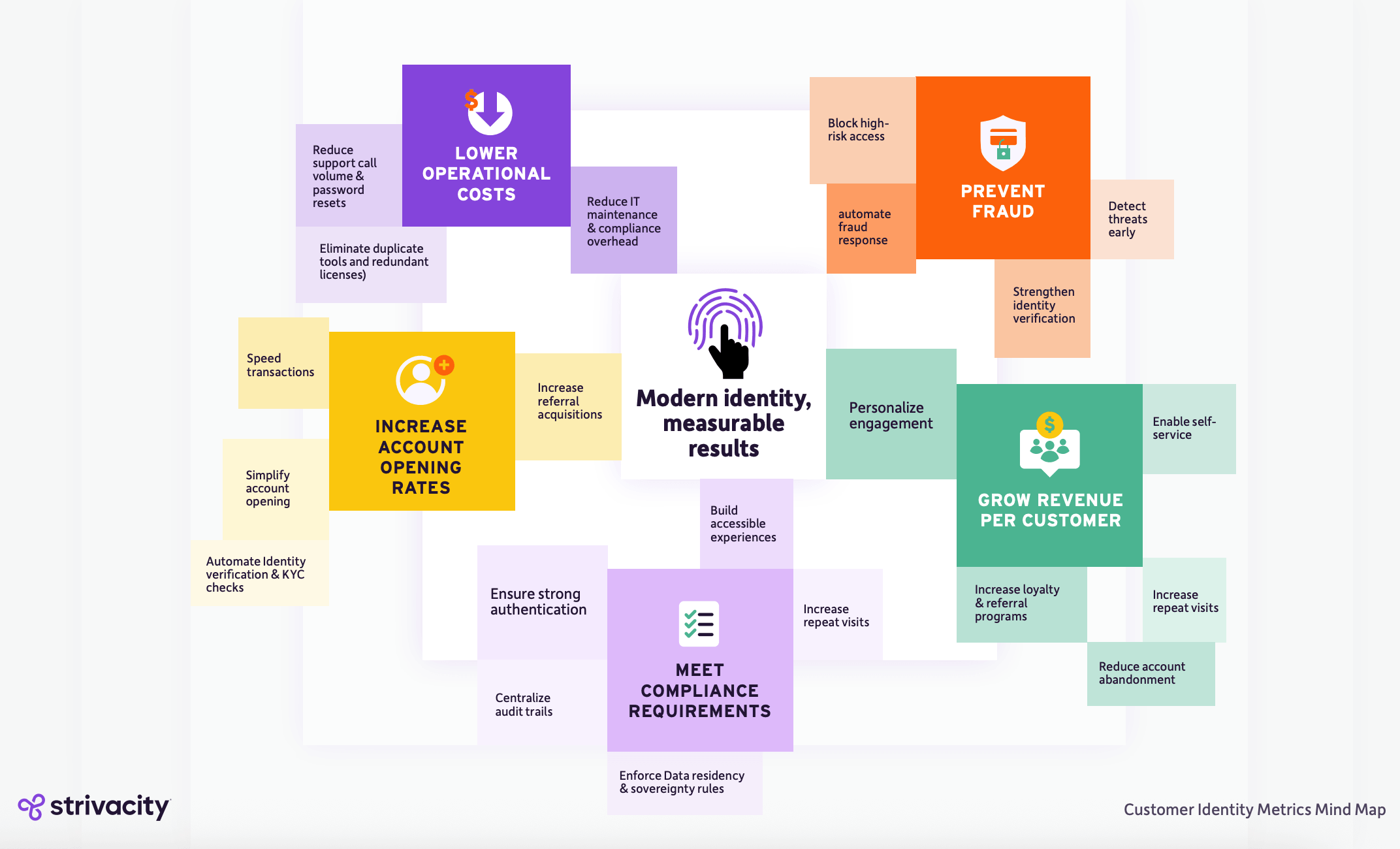
Why a mind map?
Improving customer journeys in financial services is more than just good UX. It’s a strategic balancing act between growth, compliance, and security. With teams across digital banking, fraud, marketing, compliance, and IT all focused on different KPIs, it’s easy to lose the bigger picture.
This mind map connects the dots. Whether you’re reducing account abandonment, cutting fraud, or speeding upon boarding, you’ll see how identity strategies tie directly to business outcomes.
How to use the mind map
This isn’t just a list of metrics; it’s a blueprint for aligning your identity strategy to business impact. In financial services, alignment across functions is everything. This map helps you connect the dots between experience, security, compliance, and outcomes your leadership cares about.
Here’s how to use it:
- Start with a business goal: Whether you’re trying to reduce fraud losses or increase digital conversion, begin with a clear outcome. Then use the map to identify the metrics and CIAM capabilities that support it.
- Pick a metric, work backward: Focused on a specific KPI like MFA adoption or KYC drop-off? Find it in the map and trace it back to the identity tactics that drive it.
- Align cross-functional teams: Use the mind map to get security, digital, marketing, and compliance on the same page. It clarifies how their goals connect to identity and how identity connects to growth, risk, and retention.
- Frame board-level conversations: When stakeholders ask “How does identity improve business performance?” this framework shows the path from authentication to ROI.
1. Lower operational costs
Identity friction doesn’t just frustrate customers, it drains resources. From overloaded call centers to maintenance-heavy legacy systems, inefficient sign-in experiences quietly rack up costs across your organization. The good news? Optimizing CIAM reduces operational burden while improving customer satisfaction.
Strategies to reduce the cost of sign-up and sign-in journeys:
- Lower support call volume and password resets: Sign-in issues like forgotten passwords and lockouts are a top driver of support calls. By adopting more intuitive authentication methods like passkeys, biometrics, or adaptive MFA, you reduce friction and free up your support team.
- Metric to track: % of total support volume tied to sign-in issues
- Reduce it maintenance and compliance overhead: Legacy identity systems require custom integrations, manual updates, and time consuming audits. A modern CIAM platform streamlines maintenance, simplifies compliance with regulations like GDPR, GLBA, and PCI-DSS, and provides centralized logs for faster audit readiness.
- Metric to track: % reduction in hours spent on identity related maintenance and audit preparation
- Eliminate duplicate tools and redundant licenses: Most financial institutions have accumulated point solutions for MFA, fraud detection, and consent management. Consolidating into a unified CIAM platform cuts licensing and integration costs and simplifies procurement and administration.
- Approach: Map all tools tied to sign-in and calculate total cost of ownership per MAU
- Approach: Map all tools tied to sign-in and calculate total cost of ownership per MAU
The bottom line:
Modernizing your sign-in experience pays off on both sides of the ledger. It reduces the volume of operational headaches and cuts the time and money spent stitching solutions together. In a high-margin, high-risk industry like financial services, that’s a strategic win.
See the table below for metrics and how to measure them.
2. Prevent fraud
In financial services, fraud prevention isn’t just risk management, it’s a competitive advantage. From account takeovers and credential stuffing to synthetic identity fraud at onboarding, the threats are evolving fast and getting more expensive. To stay ahead, financial institutions must proactively detect and stop fraud across the entire identity lifecycle, starting at sign-up and without compromising customer experience.
Strategies for reducing identity-related fraud:
- Detect threats early using behavioral signals: CIAM platforms use behavioral analytics including device posture and login patterns to detect anomalies before fraud occurs. Early detection reduces both direct losses and downstream investigation costs.
- Metric to track: Number of fraud attempts blocked before login success
- Use adaptive authentication to block high-risk access: Instead of treating all customers the same, adaptive authentication dynamically adjusts based on real-time context like location, device, and behavior. High-risk attempts are challenged; trusted customers get a seamless experience.
- Metric to track: % of sign-ins flagged as high-risk vs. actual confirmed fraud rate
- Strengthen identity verification at account creation: Fraud often starts at signup with stolen credentials or fake identities. Integrating identity verification tools (e.g.,document scans, liveness checks, or data validation) helps stop fraud at the front door.
- Metric to track: % of fraudulent sign-up attempts blocked during account opening
- Automate fraud response to reduce investigation time: CIAM platforms with built-in workflows and centralized logs help fraud and security teams respond faster. That means fewer manual investigations, lower recovery costs, and better protection for affected users.
- Metric to track: Average time to detect and respond to fraud incidents
- Reduce false positives to protect good customers: Overly strict fraud rule scan lock out or frustrate legitimate customers. CIAM helps fine-tune your risk engines so only suspicious activity gets flagged while trusted customers sail through.
- Best practice: Track false-positive rates and authentication-related abandonment
The bottom line:
Preventing fraud is not just about stopping bad actors. It is about balancing trust, security, and experience. A modern CIAM approach gives you the tools to do all three. By covering both sign-up and sign-in journeys, financial services firms can stay ahead of evolving threats while reducing friction and fraud-related costs.
See the table below for metrics and how to measure them.
3. Increase account opening rates
Digital acquisition is only as strong as your account opening experience. If identity checks create too much friction, customers abandon. But streamlining account opening while staying compliant with KYC and AML doesn’t have to be a trade-off. Smarter sign-up flows, personalized journeys, and real-time verification tools remove hurdles without compromising on security. This helps you turn more prospects into loyal customers.
Strategies to turn more prospects into customers:
- Simplify the sign-up experience: Replace long forms and confusing flows with progressive profiling and saved-state onboarding. Let customers sign up using existing credentials(federated login, ID verification services) to reduce drop-off.
- Metric to track: Sign-up conversion rate and onboarding abandonment, A/B test account opening experiences success
- Automate identity verification and KYC checks: Manual reviews delay account opening and drive drop-off. Embed real-time verification using IDV tools that meet compliance standards (KYC,AML, NAIC), all without routing users to offline or high-friction steps.
- Metric to track: KYC pass rate, time to verify, drop-off during verification
- Speed up time to first transaction: Don’t stop at “account created.” Use post-login call-to-actions and personalized landing pages to guide customers directly to their first value-driving action like funding an account or starting a quote.
- Metric to track: Average time to first transaction
- Reduce friction for return visits: Make reauthentication seamless. Remember trusted devices, offer passwordless options, and adapt MFA based on user context so returning customers can pick up right where they left off.
- Metric to track: Returning customer sign-in success rate
- Increase acquisition through referrals: Referral programs drive acquisition but only if customers can access and share them easily. Embed referral prompts securely into the account opening flow with built-in fraud protections and compliance controls.
- Metric to track: Invite-to-sign-up referral rate
The bottom line:
Simplifying account opening isn’t just about aesthetics. It directly improves acquisition ROI, speeds up revenue, and reduces the chance that fraud or compliance checks block the path to customer growth.
See the table below for metrics and how to measure them.
4. Grow revenue per customer
The sign-in experience isn’t just a security checkpoint, it’s a revenue moment. Once a customer logs in, you’ve got a powerful opportunity to deepen the relationship, deliver personalized value, and increase share of wallet.
CIAM plays a critical role in turning passive customers into active ones, driving upsell, loyalty, and long-term engagement all while lowering acquisition costs.
Strategies to increase customer value:
- Personalize engagement using identity signals: Knowing who your customeris and what they need is the foundation of every high-value interaction. Unified identities let you tailor your customers account management experience, product recommendations, and content across web, mobile, and in-branch experiences.
- Metric to track: Cross-sell/upsell conversion rate post-login
- Drive recurring usage through seamless access: Friction at login drives churn. Passwordless authentication, remembered devices, and biometrics help customers come back more often and stick around longer.
- Metric to track: Login frequency and session duration
- Enable self-service product enrollment: Give customers the ability to discover and activate products without needing to call an agent. Streamlined enrollment drives higher adoption of cross-sell and upsell offers.
- Metric to track: % of users enrolling in products without assistance
- Recover dormant or abandoned accounts: Forgotten credentials often lead to lost revenue. A strong CIAM platform supports secure, self-service account recovery that prevents abandonment and preserves lifetime value.
- Metric to track: Account recovery success rate and retention after recovery
- Power loyalty and referral engagement: Engaged customers become advocates. CIAM helps power secure, compliant referral programs and enables personalized loyalty tracking all tied to a unified customer profile.
- Metric to track: Referral sign-up conversion and loyalty program opt-in rate
The bottom line:
A well-orchestrated identity experience doesn’t just protect customer accounts, it grows them. The right CIAM strategies help financial institutions maximize the value of every customer who signs in, increasing revenue while building lasting trust.
See the table below for metrics and how to measure them.
5. Meet compliance requirements
Compliance pressure keeps rising but that doesn’t mean your experience has to suffer. From GDPR to NYDFS, PSD2, and WCAG, modern CIAM helps you embed requirements directly into your sign-in flow without adding user friction.
With built-in logging, access control, consent management, and regional data handling, you can meet mandates efficiently and prove it at audit time.
Strategies to reduce compliance risk:
- Centralize consent and audit trails: Many banks still manage consent and audit data in fragmented systems, a recipe for compliance gaps. A modern CIAM platform captures and versions consent at login or registration, logs account activity, and creates tamper-proof records.
- Metric to track: % of users with valid consent logs; time to generate audit report
- Enforce secure access without creating friction: Regulations like NYDFS, PSD2, and GLBA require strong customer authentication. CIAM helps you meet these mandates with adaptive MFA, risk-based step-up, and passkeys to improve both security and usability.
- Metric to track: MFA adoption rate and failed login attempts by authentication method
- Build accessibility into every login flow: Standards like ADA, Section 508, and WCAG require that all users, including those with disabilities, can access digital services independently. CIAM platforms ensure login screens and recovery flows support screen readers, keyboard navigation, and high-contrast modes.
- Metric to track: Accessibility test success rate and audit readiness
- Respect data residency and sovereignty rules: GDPR, PIPEDA, and APAC data laws require you to store and process data regionally. CIAM gives you control over where identities live and how they’re handled with location-specific backup, audit, and processing options.
- Metric to track: % of customer data stored within required regions
- Enable rights management and portability: GDPR and CCPA grant users the right to access or delete their data. Modern CIAM supports automated deletion and export flows, complete with logs to prove fulfillment within SLAs.
- Metric to track: Fulfillment time for deletion/export requests and error rates
The bottom line:
You don’t have to sacrifice user experience to meet regulatory requirements. With the right CIAM capabilities, you can build compliant, audit-ready customer journeys that also feel seamless, accessible, and secure.
See the table below for metrics and how to measure them.

Prefer a PDF?
Download the full Ebook to read offline or share.

Schedule a time to meet with us
Just starting your CIAM research? Ready for a product demo? Curious about replacing your current CIAM solution? Schedule time with one of our identity experts for a meeting tailored to your specific needs.