

.svg)
Retail customer identity metrics: The KPIs every retailer should track for conversion, loyalty, fraud prevention and agentic commerce readiness

Retailers measure nearly every part of the customer journey: traffic, cart abandonment, checkout completion, average order value, and repeat purchases.
But one of the most influential parts of that journey often remains buried in technical dashboards: customer identity.
Identity sits in front of nearly every high-value interaction. Customers encounter it when they create an account, sign in, recover access, complete a purchase, join a loyalty program, or move between channels.
When identity works, customers barely notice it. When it creates friction, shoppers leave. When security controls are too aggressive, legitimate customers get blocked. And when identity struggles during Black Friday, a flash sale, or a seasonal surge, the business loses revenue when the stakes are highest.
Most retailers think of identity as something that protects the business. It also helps grow it. Every sign up, sign in, password reset, and fraud decision can influence revenue just as much as it influences security.
Why retailers need a shared identity measurement model
Retail identity is owned by multiple teams but rarely measured as one connected system.
Security focuses on fraud. Digital focuses on conversion. Product focuses on speed. Marketing focuses on engagement. Engineering focuses on performance and uptime.
The customer experiences all of it as one journey.
A shared measurement model helps teams connect identity decisions to the business outcomes retailers already track. Those outcomes fall into five areas.
1. Convert more shoppers
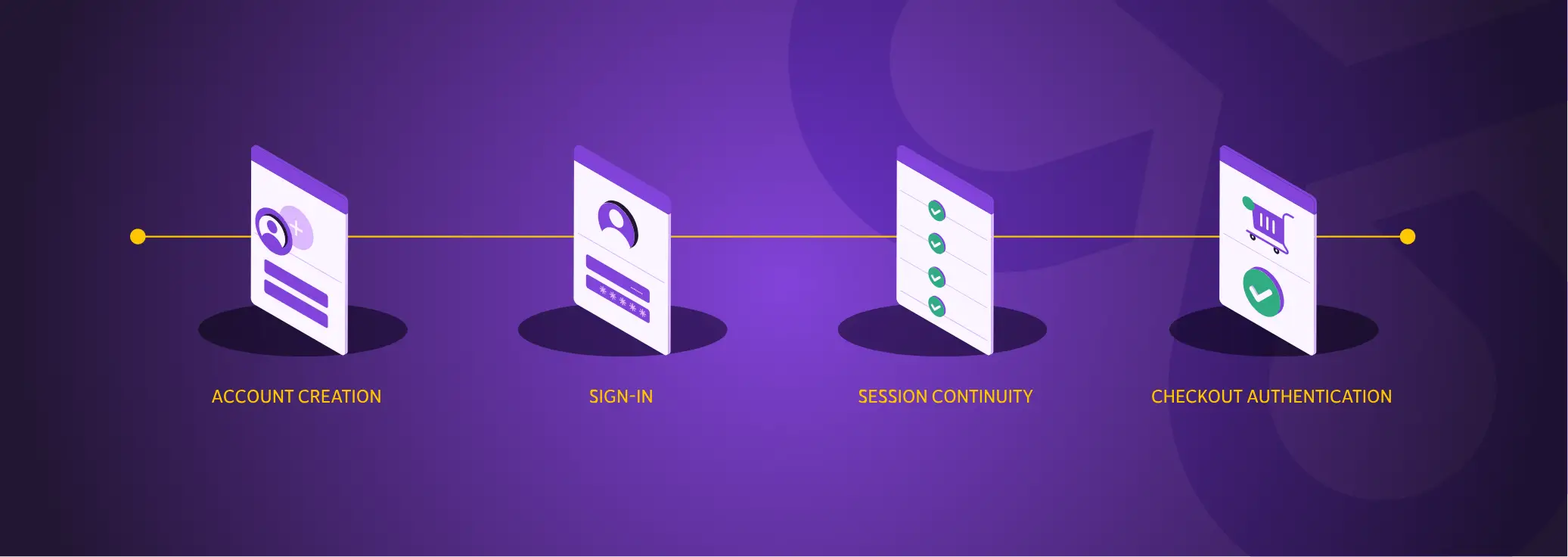
Retailers often think conversion happens on a product page or at checkout. In reality, it depends on a series of identity-driven moments, including account creation, sign in, recovery, session continuity, and checkout authentication.
Friction at any one of those steps can cost the sale, and checkout abandonment is often an identity problem wearing a UX label.
Retailers should measure:
- Account creation success and abandonment
- Sign in success and failure reasons
- Password reset and recovery success
- Mobile sign in performance
- Checkout completion and checkout abandonment
- Guest-to-account conversion
These metrics expose whether identity is helping customers buy or creating another reason to leave.
The goal is to reduce unnecessary friction while maintaining strong security. Progressive profiling, passkeys, passwordless access, remembered devices, social sign in, and adaptive authentication can simplify the experience while applying stronger controls when risk warrants them.
Guest checkout also matters. Retailers should make purchasing easy first, then create a clear value exchange that encourages customers to save preferences, track orders, or join loyalty after the transaction.
2. Protect every account without blocking good customers
Retail accounts contain personal data, saved payment methods, order histories, and loyalty balances that can be monetized quickly.
Account takeover is the sharpest version of this risk. Attackers commonly use stolen credentials to automate sign in attempts across retail sites. They also target account recovery because a weak reset process can offer an easier route into an account than the original sign in.
But security can create its own revenue problem when legitimate customers are challenged or blocked too often.
Retailers should monitor:
- Identity verification outcomes
- Blocked sessions by reason
- Step-up authentication completion
- False positive rates
- Account recovery requests
- Account takeover activity
- Loyalty fraud and suspicious loyalty redemptions
These metrics should be reviewed together. A high number of blocked sessions may indicate successful fraud prevention, but it may also mean trusted shoppers cannot complete purchases.
The objective is to recognize risk earlier, apply the right control, and let legitimate customers continue with as little interruption as possible.
3. Build loyalty through trusted personalization
Personalization depends on recognition. Customers expect retailers to remember their preferences, loyalty status, order history, and previous interactions across websites, apps, stores, and customer service. They do not expect to start over every time they change channels.
Identity provides the continuity that makes personalization possible, but trust has to come first.
Retailers should measure:
- Active account rate
- Known versus anonymous customer rate
- Omnichannel recognition
- Consent opt-in
- Loyalty engagement
- Profile and preference completion
The goal is to create better experiences using information customers knowingly share. Unified profiles, account linking, progressive profiling, consent management, and low-friction access can help retailers recognize customers consistently without making the experience feel invasive.
4. Increase agility and lower total cost of ownership
Identity also affects how quickly the business can move.
When every registration, sign in update, consent request, or new brand launch requires engineering work, identity becomes a bottleneck. When multiple products handle separate parts of the customer journey, teams spend more time integrating systems, troubleshooting failures, and piecing together data.
Retailers should look beyond licensing costs and track:
- Time to launch or change a journey
- Number of identity products and vendors
- Identity-related support tickets
- Engineering effort for routine updates
- Cost per active identity
- Performance during peak periods
A lower product price does not necessarily mean a lower total cost. Complexity adds cost through integrations, support, development work, slower launches, and lost revenue.
The better approach is to reduce complexity, standardize common journeys, and give product and digital teams more control over routine changes.
5. Prepare for agentic commerce
Retail identity is expanding beyond human customers. Agentic commerce, AI agents that discover products, make purchase decisions, and complete transactions on a customer's behalf, is no longer a future scenario. AI shopping assistants are already helping customers discover products and make decisions today, and that footprint is growing quickly.
Over time, agents will increasingly interact with accounts, place orders, manage subscriptions, redeem loyalty benefits, and update information on a customer's behalf.
Retailers will need to answer new identity questions:
- Which agent is acting?
- Who authorized it?
- What is it allowed to do?
- How long does that authority last?
- Which actions require additional approval?
- Can every action be audited?
AI agents should be treated as identities, not simply as tools. That means verifying the agent, connecting it to the customer it represents, defining the scope of its authority, applying adaptive controls, and maintaining a complete audit trail.
Most retailers are not ready to measure all of this today. But as agentic commerce matures, agent verification, delegated authority, customer consent, and auditability should become part of the identity roadmap now, not after adoption accelerates.
Which retail identity metrics should you track first?
Retailers do not need to measure everything at once. Start with the metrics that answer three questions:
- Where is identity creating revenue loss? Look at account creation, sign-in, recovery, mobile performance, cart abandonment, and checkout completion.
- Where is security creating unnecessary friction? Compare verification outcomes, blocked sessions, step-up challenges, false positives, and recovery activity.
- Where is customer trust creating long-term value? Measure active accounts, known customers, loyalty engagement, consent, and recognition across channels.
Once those areas are visible, teams can begin measuring identity complexity, operating cost, and readiness for agentic commerce.
Retail identity is a business metric
Every registration field, sign in prompt, recovery flow, consent interaction, and fraud check affects whether a shopper converts, whether they trust the brand, and whether they return.
The retailers that get identity right will not measure it only through uptime and authentication success. They will connect it to conversion, revenue, loyalty, fraud reduction, speed, and customer lifetime value.
Customer identity is part of the retail revenue engine. It's time to measure it that way.
See where identity impacts your retail business
Download the Retail Identity & Metrics Mind Map for the complete framework, including performance benchmarks, priority actions, metric definitions, formulas, and recommended owners.
Frequently Asked Questions
What are retail customer identity metrics?
Retail customer identity metrics measure how identity affects business outcomes, not just authentication. They help retailers understand how account creation, sign in, account recovery, fraud prevention, customer recognition, and consent influence conversion, loyalty, operational efficiency, and customer lifetime value.
Which retail customer identity metrics should you track first?
Start with the metrics that have the greatest impact on revenue and customer experience, including:
- Account creation success and abandonment
- Sign in success
- Password reset and account recovery success
- Checkout completion and checkout abandonment
- Identity verification outcomes
- False positive rates
- Known versus anonymous customer rate
- Omnichannel recognition
As your identity program matures, you can expand to operational metrics, AI governance, and customer lifetime value.
How does customer identity affect retail conversion?
Identity influences conversion long before checkout. Friction during account creation, sign in, password recovery, or authentication can cause shoppers to abandon their purchase. Improving these journeys helps retailers increase conversion without increasing marketing spend.
How does customer identity improve customer loyalty?
Identity enables retailers to recognize returning customers, remember preferences, personalize experiences, manage consent, and create consistent experiences across web, mobile, and in-store channels. These capabilities strengthen customer relationships and encourage repeat purchases.
What is account takeover fraud, and how can retailers reduce it without creating more friction?
Account takeover fraud happens when an attacker gains unauthorized access to a legitimate customer's account, typically using stolen or automated credentials, and uses it to make purchases, drain loyalty balances, or harvest personal data. The goal in preventing it isn't to challenge every customer. It's to apply additional verification only when risk is high. Adaptive authentication, identity verification, device recognition, step-up authentication, and fraud signals help protect customer accounts while allowing trusted shoppers to move through their journey with minimal interruption.
Why should retailers measure identity as a business KPI?
Identity affects many of the outcomes retailers already measure, including conversion, repeat purchases, fraud losses, support costs, and customer lifetime value. Measuring identity alongside these business KPIs helps teams understand where identity is creating value and where it's creating unnecessary friction.
What does agentic commerce mean for customer identity?
As AI shopping assistants and AI agents begin discovering products, placing orders, and interacting with customer accounts, retailers will need to verify those agents, define what they are allowed to do, record customer consent, and maintain a complete audit trail. Customer identity will become the trust layer that governs these interactions.
How should retailers prevent fraud from AI shopping agents?
The same adaptive-risk principle that applies to human customers applies to agents acting on their behalf: verify the agent's identity, confirm it was authorized by the actual customer, scope what it's allowed to do, and apply step-up controls when an action falls outside that scope. Treating agents as identities rather than as generic API traffic is what makes this enforceable and auditable.