

.svg)
Five signs you've outgrown Okta and Ping Identity for CIAM

Every generation of technology forces businesses to rethink their architecture. Cloud computing changed infrastructure. Mobile changed customer experiences. AI is changing customer identity.
For years, customer identity and access management (CIAM) had one primary job: authenticate people accessing websites and mobile apps. It was built for a world of human users, digital channels, and fairly predictable customer journeys.
That isn't the world we operate in anymore.
Today, customer identity has to secure partners, govern AI agents acting on behalf of customers, reduce fraud, manage consent, protect privacy, and help businesses launch new digital experiences faster than ever.
The question isn't whether legacy CIAM vendors are adding AI capabilities. They are. The real question is whether products designed for the last generation of customer identity can evolve fast enough for the next one.
You probably won't notice the answer all at once. Instead, it shows up in the projects that take longer than they should. The extra products you have to license. The policies that don't behave consistently across channels. The growing complexity of managing identities across customers, partners, and now AI agents.
If those problems sound familiar, it may not be your team that's reached its limit. It may be your CIAM product.
Here are five signs you've outgrown Okta and Ping Identity for CIAM, and why the AI era demands a different approach.
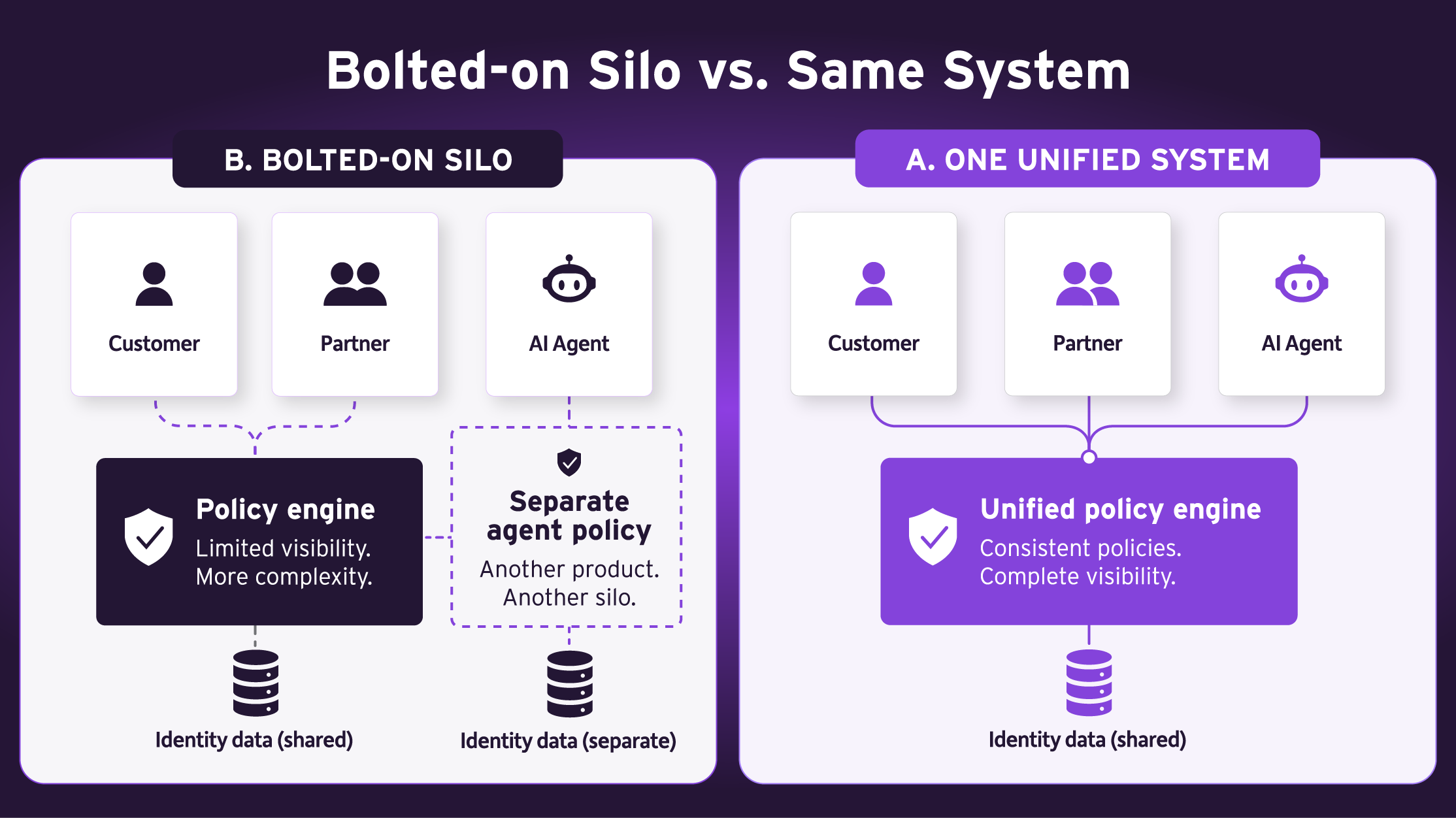
1. Your identity stack is a portfolio, not one product
If every new identity project seems to require another console, another integration, or another specialist, it's worth asking a simple question: are you using one product or managing a portfolio?
If you're running Okta Customer Identity, Auth0, Ping Identity, or another established CIAM product, look at how your identity capabilities have evolved over time. Many vendors have expanded through acquisitions, new modules, and separately licensed services. That's not inherently a problem, until your team is responsible for making all those pieces work together.
The user experience may appear seamless. The architecture behind it often isn't.
You notice the difference when a policy change needs to be applied everywhere but isn't. When upgrading one service means validating integrations across others. When administrators have to know which product owns authentication, orchestration, consent, or fraud prevention before they can troubleshoot an issue or launch a new experience.
Over time, teams accumulate institutional knowledge about exceptions, dependencies, and workarounds. That's not just a training challenge. It's the operational cost of managing a portfolio instead of a single product.
A modern CIAM product should give you one place to configure journeys, apply consistent policies, manage identities, and understand what's happening across every customer, partner, and AI agent interaction.
2. Identity is slowing down digital launches
Ask your product and digital teams what slows down the launch of a new customer experience.
Eventually, many organizations stop asking, "What's the best experience for our customers?" and start asking, "What can our identity product support?"
Adding a registration journey, launching a new application, supporting another customer segment, or introducing a new authentication method turns into a development project instead of a configuration task.
Small changes pile up in the backlog. Launch dates depend on specialized identity resources. What should have taken hours stretches into weeks because identity has become the bottleneck.
Modern customer identity should make common journeys fast to configure while still giving developers the flexibility to extend them when needed. It should support the pace of the business, not dictate it.
If identity is consistently the longest part of launching a new digital experience, the problem may not be your process. It may be the product underneath it.
3. AI agent identity creates another silo
AI agents acting on behalf of customers create a delegation problem, not just an authentication problem.
The business needs to know who the agent represents, what the customer authorized it to do, which resources it can access, when those permissions expire, and what actions the agent performed.
Nearly every major identity vendor now has an AI agent story. The important question isn't whether the capability exists but whether that capability extends your existing customer identity strategy or creates another identity silo.
Does agent identity live alongside customer identity?
Can customers see which agents they've authorized and revoke access at any time?
Can security teams apply the same policies across customers, partners, and AI agents?
Or does supporting AI introduce another product, another console, another policy layer, and another contract?
AI agent identity should build on the same identity context, consent model, policy framework, and audit trail you're already using. If supporting AI requires another disconnected identity layer, you're recreating the same fragmentation that made legacy CIAM difficult to manage in the first place.
4. Isolation and predictable performance cost extra
Customer identity sits directly in the path of revenue. When customers cannot register, sign in, recover an account, or complete a transaction, the impact is immediate. That's why deployment architecture matters more than many organizations realize.
Yet capabilities like dedicated environments, regional deployment, predictable performance, and stronger isolation are often reserved for higher-priced editions or sold as premium add-ons.
That raises an important question: why should the architecture your business depends on cost extra?
Dedicated architecture should be the foundation of customer identity, not an upgrade reserved for the largest contracts.
If the deployment model your business needs only becomes available after moving to a premium edition, you're not paying for more capability. You're paying to overcome the limitations of the default architecture.
5. Identity cannot tell you where the experience is failing
Your CIAM product sees every registration, sign-in, authentication challenge, password reset, recovery attempt, and abandoned journey. It should be able to tell you what is working.
Where are customers dropping out of registration? Which authentication methods perform best? Are fraud controls creating unnecessary friction? Did a recent journey change improve completion rates or make them worse?
For many organizations, answering those questions requires exporting data, building custom reports, or purchasing a separate analytics product. Security teams can see events. Digital teams can see conversion. Product teams can see application behavior. Nobody has a single view of how identity affects all three.
That is a missed opportunity.
Customer identity should do more than process sign-ins. It should give security, product, and digital teams the insight to improve journeys, reduce abandonment, and understand where controls are helping or hurting the customer experience.
If your CIAM product records activity but cannot turn it into useful business insight, it is only solving part of the problem.
What This Adds Up To
None of these signs is a crisis on its own. Together, they point to something bigger: the role of customer identity has changed.
The AI era isn't replacing customer identity. It's raising the bar for what customer identity needs to do.
It needs to help businesses launch digital experiences faster, protect against evolving threats, govern customers, partners, and AI agents consistently, and provide the insight to improve both security and customer experience.
The next generation of CIAM won't be defined by who adds AI features first. It will be defined by whose identity architecture is ready for AI.
If your current product can't deliver that without adding complexity, it may be time to ask a different question. Not "Does our CIAM product still work?" but "Is it built for where our business is going next?"
We believe modern customer identity should work as one system, not a collection of products. That's why Strivacity brings customer, partner, and AI agent identity together in one product, with dedicated single-instance SaaS, consistent policies, and identity insights built in.
If you're approaching an Okta or Ping Identity renewal, now is the time to ask whether your current identity architecture is ready for what's next.
What is legacy CIAM?
Legacy CIAM refers to customer identity and access management products built for an earlier era: human users, digital-only channels, and fairly predictable customer journeys. As identity has expanded to cover partners, AI agents, fraud, and consent, some of these products have kept up by bolting on separate modules and acquisitions rather than evolving as a single system.
What are the signs you've outgrown your CIAM product?
Five common signs: your identity stack has become a portfolio of separate products instead of one; identity has become the bottleneck for launching new digital experiences; AI agent identity is handled as a separate silo instead of alongside customer identity; isolation and predictable performance are sold as premium add-ons rather than included by default; and your CIAM product can't tell you where customers are dropping out of a journey.
Does AI agent identity need its own CIAM product?
Not necessarily. The better approach is for AI agent identity to run on the same identity context, consent model, policy framework, and audit trail as customer and partner identity, rather than requiring a separate product, console, or contract to manage AI agents.
Why does CIAM architecture matter more than CIAM features?
Most CIAM vendors can demo similar features. What differs is what happens after go-live: whether policy changes apply consistently across the product, whether launching a new experience is a configuration task or a development project, and whether dedicated, isolated infrastructure is included by default or sold as a premium upgrade.
Should isolation and dedicated infrastructure cost extra with a CIAM provider?
No. Since customer identity sits directly in the path of revenue, dedicated environments and predictable performance should be the foundation of the product, not an upgrade reserved for the largest contracts.